I chose this research area cause I had some experience with coworking design and design management. As a design manager, I always think about how to improve the business value of this industry by design. I try to find the answer from space design, branding design, and corporate identity. However, they do not make sense. I ask myself if you are a consumer, except convenient transportation, good environment, and cheap price, what else you want to get from coworking space. Finally, I moved to service design. Following are some fragment of my essay “service design in coworking industry”

some fragment from my essay
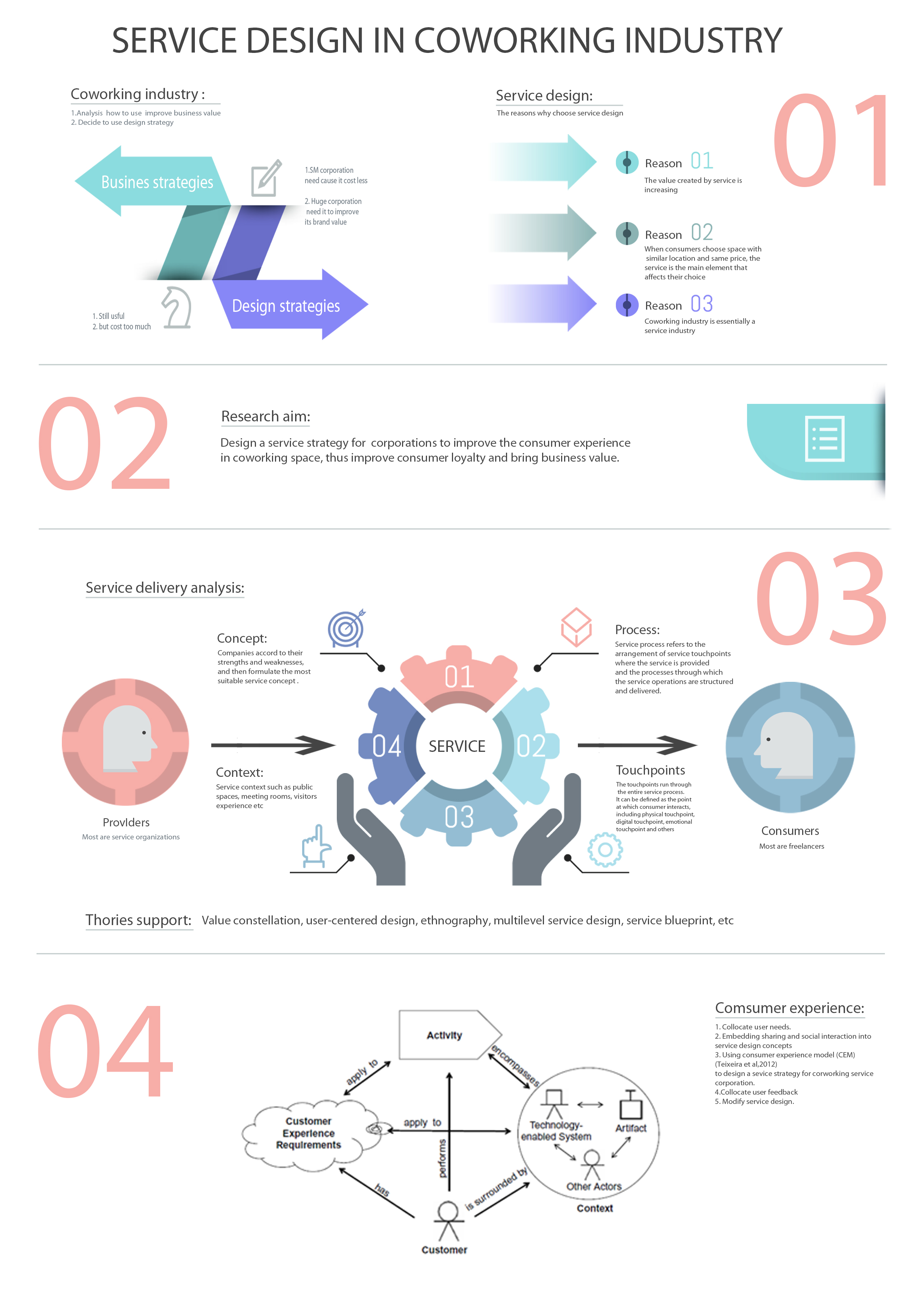
According to the image3, the core of the mind-map is author’s research area: service design in the coworking industry. The circles surrounding are the main topics or objects in this area. The first of all is the stakeholder which including service providers, consumers and other indirect people such as suppliers and sponsors. And then the whole map’s relationship can be summarised that service providers offer consumers service through service processes which are constituted by different touchpoints. These touchpoints including physical goods, digital touchpoints, emotional touchpoints, invisible touchpoints etc. Moreover, different service contexts have different processes, and all of these processes constitute the coworking service system.
Despite the modern service system is complex, and a large number of stakeholders are involved, the immediate audience for the service is always the users or consumers. Thus, consumers could be the major element in service design. However, Zomerdijk and Voss (2010) pointed out that the period when companies only relied on product quality to attract consumers has passed. With the increase in consumption level, consumers are not only satisfied with the products, but also begin to care more about a series of related services, such as consumption experience and after-sales service (Richardson, 2017). Therefore, in order to satisfy customers’ need, current firms should pay more attention to service.
Different companies have diverse service systems (Capdevila, 2014). Basically, a service system clarified by more than one service process. These processes are designed based on the same service concept and is represented in the form of a blueprint (Morelli, 2002). The whole coworking services system is occurring when consumers punch the clock and go into the office space. And now it may happen before the consumer arrives the office space, for example, booking meeting rooms by phones on the way to work (Richardson, 2017).
Halvorsrud et al (2016) stated that ‘‘service process refers to the arrangement of service touchpoints where the service is provided and the processes through which the service operations are structured and delivered.’’ The difference of service context such as public spaces, meeting rooms, visitors experience etc determined that service process is not the same (Zomerdijk and Voss, 2010). However, Teixeira et al (2012) reported that good service is not just a procedure that providers offering for the consumers, it is a process that invites consumers to join in. Therefore, designing a suitable service process requires designers to create an unforgettable customer experience with several touchpoints based on different context.
The touchpoints run through the entire service process. It can be defined as the point at which consumer interacts, including physical touchpoint, digital touchpoint, emotional touchpoint and others (Patrício and Fisk, 2013). With the development of technology, these digital touchpoints with new technology could greatly improve the quality of the customer experience (Richardson, 2017). When consumers contact these touchpoints, they react to the service and create an experience (Halvorsrud et al, 2016). Thus how to manage different touch points in the service process is directly related to the user experience. Besides that, compared with physical touchpoints, the human touchpoints including employees and other consumers are more difficult to manage, this kind of human issues also need to be considered in modern service design (Cook et al, 2002).











 Charlotte